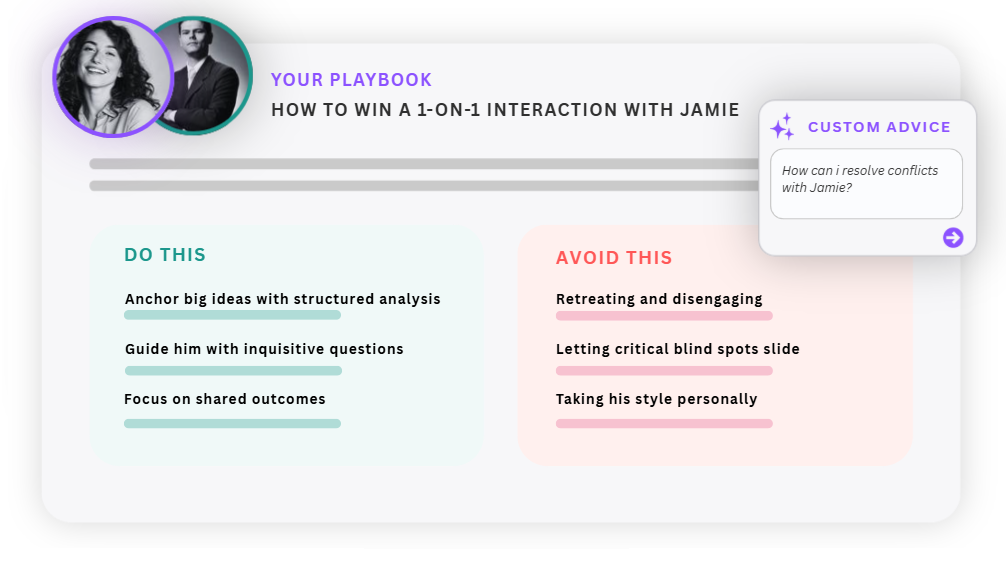
Custom AI playbooks to win
every 1-on-1 interaction with anyone
BUILT FOR THE CONVERSATIONS THAT DECIDE THINGS:
Use our unique profiling tool to help structure a comprehensive description of anyone.
Use the 'wisdom of crowds' to get a more accurate view, based on everyone else's insights
Anyone - a buyer, a hire, a colleague, the in-laws. Move the sliders. No tests, no quizzes. Two minutes end-to-end.
Do the same for yourself. Instantly mirror yourself against them to capture relationship dynamics.
AI maps your insights. Get the right approaches to navigate difficult interactions.
Ask others who know your connection to add their views. Getting more viewpoints creates a sharper, objective baseline no standard AI can replicate.
We'll generate a playbook for you on how to win every 1-on-1 interaction with them
Start by describing what they're like, using our unique profiling tool:
Generic AI has a context problem. It relies on whatever you type then tries to figure out what you really mean. Different inputs create different outputs, making the advice subjective, inconsistent and often built on guesswork.
The FixViewsOnYou replaces assumptions with understanding. Our tools create a clear picture of how both people are wired, how they interact and where friction or opportunity is likely to appear. Combined with perspectives from people who actually know them, AI gets access to a level of context a simple prompt can never provide. The result is custom playbooks designed for the relationship in front of you, not an average one.
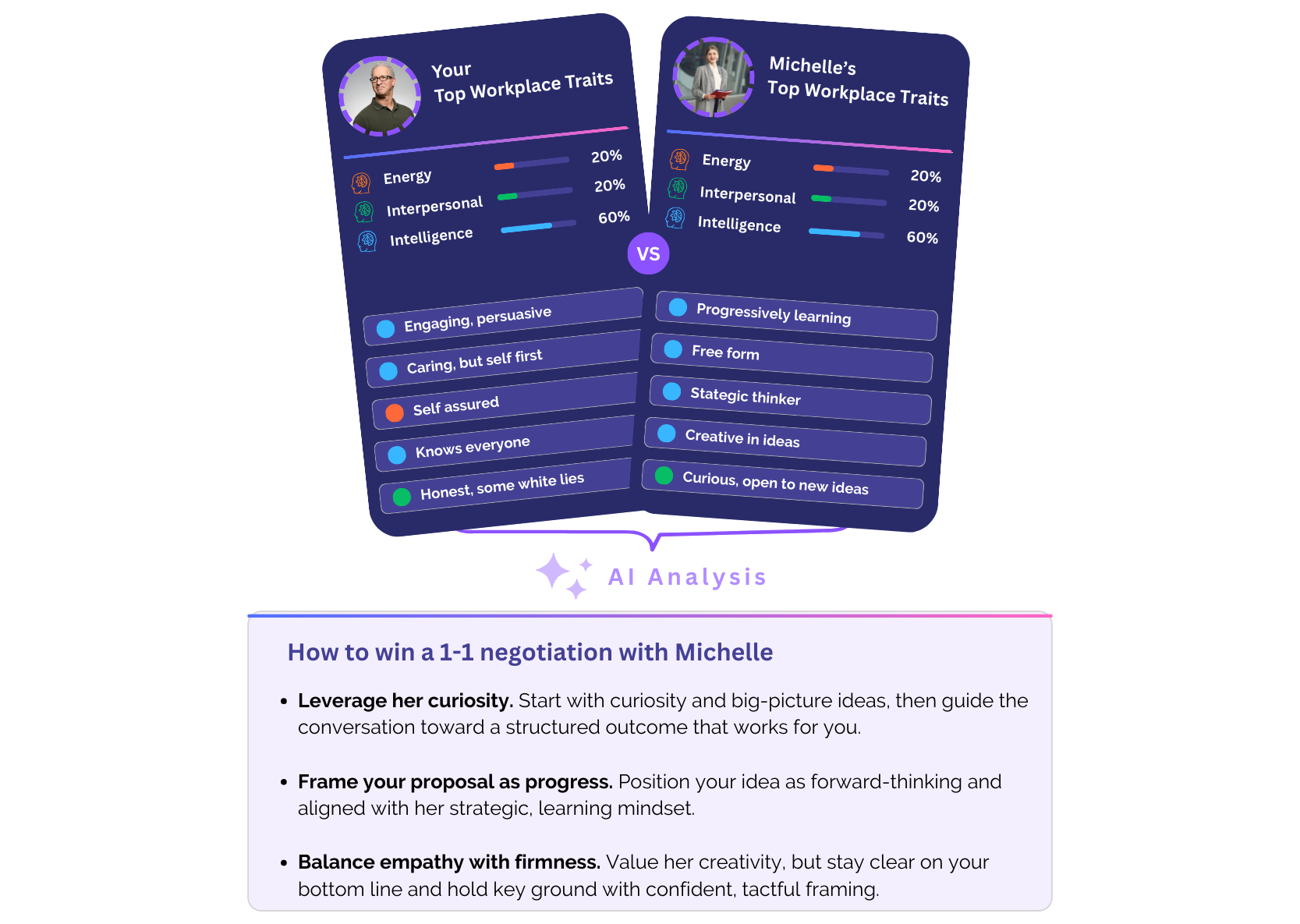
What happens when you stop guessing how someone thinks - and start working with it.
Used it to figure out why my colleague and I always clash on timing. Turns out we view project urgency through totally different lenses. I used the playbook's exact framing to talk their language.
Ran a playbook right before pitching a notoriously brutal client. The playbook basically said: 'Drop the visionary talk. They only care about metrics.' I shifted my entire intro to hard data. Hooked them instantly.
My co-founder and I had hit gridlock on future product direction. Mapped our traits on the sliders and realized it was a classic, invisible ego clash. The recommended de-escalation script killed the tension on the very next call.
Three research-backed ingredients - not prompts, not guesswork.
The science behind ViewsOnYou
ViewsOnYou isn't built on gut feel or generic AI prompts. It draws on three well-established bodies of research to generate strategies calibrated to the specific relationship in front of you.
Openness, Conscientiousness, Extraversion, Agreeableness, Neuroticism - the most replicated framework in personality psychology. More than 50 years of peer-reviewed research shows these five dimensions predict how people communicate, make decisions, handle conflict, and respond to persuasion.
Foundational • Costa & McCrae, 1992We see ourselves differently from how others see us. Research in social perception consistently shows that aggregating multiple external viewpoints produces a more accurate behavioural picture than self-assessment alone. Our crowd-sourcing feature is this principle applied practically.
Kenny & DePaulo • Funder & ColvinLarge language models perform significantly better when given structured, calibrated input rather than open-ended prompts. Our trait sliders and relationship dynamics create the rich context that general AI can never infer from a single message - enabling responses that are genuinely tailored, not just plausible.
LLM grounding research • 2023-2024Decades of research in interpersonal theory show that communication strategies work best when they match - not mirror - the other person's behavioural style. ViewsOnYou maps the relationship dynamic between two people so the AI can recommend approaches that fit the actual interplay, not an average one.
Kiesler's circumplex model • 1983The trait scales are statistically validated using correlation analysis and standard deviation testing across our user base. This confirms the scales capture genuine, independent dimensions of behaviour rather than overlapping or redundant signals.
These aren't theoretical frameworks - they're the structural reason why describing someone accurately produces better strategies than simply asking an AI to help you handle a conversation. The intelligence is in the input.